Skip to content
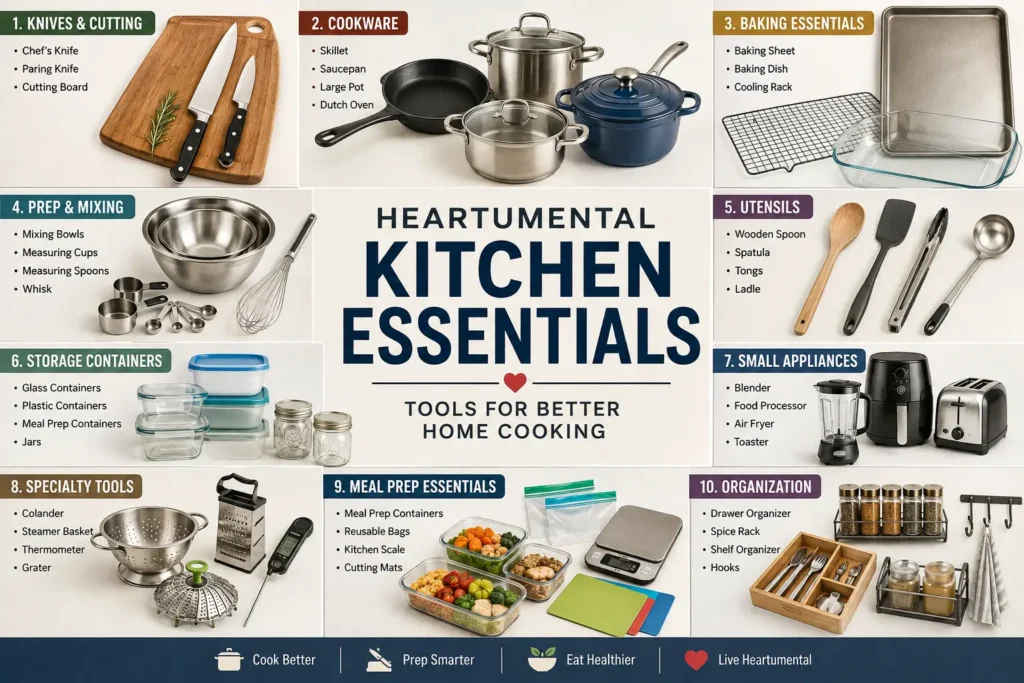
A good kitchen does not need dozens of gadgets. I find that a small set of reliable tools can make everyday cooking much easier, especially when you prepare meals from whole foods and cook at home often.
This guide to Heartumental kitchen essentials focuses on the equipment that helps with preparation, cooking, storage, and meal prep. You will find practical advice on cookware, knives, cutting boards, measuring tools, storage containers, small appliances, and kitchen organization.
The goal is simple: build a kitchen that makes it easier to prepare breakfast, lunch, dinner, brunch, and make-ahead meals without filling every cupboard with equipment you rarely use.
What Makes a Kitchen Work for Heartumental Cooking?
The Heartumental approach is less about owning special equipment and more about having the right tools for regular home cooking.
A useful kitchen should make basic tasks such as chopping vegetables, cooking grains, preparing eggs, roasting vegetables, grilling food, blending sauces, and storing leftovers straightforward.
I prefer tools that can perform several jobs instead of buying a separate gadget for every recipe. A good chef’s knife, sturdy cutting board, quality skillet, saucepan, baking sheet, and storage containers can cover a large part of everyday cooking.
The kitchen should also support different cooking methods. Baking, roasting, steaming, grilling, sautéing, simmering, and blending all require slightly different equipment.
Storage matters too. If you prepare food ahead, good containers can make the difference between a useful meal-prep routine and a refrigerator full of forgotten leftovers.
You also do not need to buy everything at once. Start with the tools you use most, then add equipment as your cooking habits grow.
The Core Kitchen Tools You Actually Need

Before buying specialist equipment, I would build the kitchen around a few dependable basics.
| Kitchen essential | Main use | Priority |
| Chef’s knife | Chopping, slicing and cutting | High |
| Cutting board | Food preparation | High |
| Large skillet | Sautéing, eggs and one-pan meals | High |
| Saucepan | Grains, sauces and simmering | High |
| Baking sheet | Roasting and baking | High |
| Mixing bowls | Preparation and mixing | High |
| Measuring cups and spoons | Recipe accuracy | High |
| Wooden or silicone utensils | Stirring and cooking | High |
| Food storage containers | Meal prep and leftovers | High |
| Colander | Washing and draining | High |
| Tongs | Turning and serving | Medium |
| Instant-read thermometer | Checking cooked foods | Medium |
| Blender | Smoothies and blended foods | Medium |
| Steamer basket | Steaming vegetables and other foods | Medium |
This list is enough for most home cooks to get started.
You can add specialty equipment later based on the meals you actually make.
Knives and Cutting Boards

A good knife is one of the most useful purchases for any home kitchen.
You do not need a large knife set. A chef’s knife can handle most chopping and slicing jobs, while a small paring knife is useful for smaller foods and detailed work.
Chef’s Knife
A chef’s knife is useful for:
- Chopping vegetables
- Slicing fruit
- Cutting cooked meat
- Mincing herbs
- Preparing larger foods
- Breaking down some whole foods
Choose a knife that feels comfortable in your hand. Weight and handle shape are personal, so the most expensive knife is not automatically the best choice.
I would rather have one comfortable, sharp knife than a large set of knives that rarely gets used.
Paring Knife
A small paring knife works well for:
- Peeling
- Trimming
- Coring fruit
- Cutting small vegetables
- Preparing garnishes
It is especially useful for smaller kitchen tasks where a chef’s knife feels too large.
Cutting Boards
A cutting board should provide enough space to work without forcing food onto the counter.
Having two boards can also be useful. You can use one mainly for produce and another for foods that require separate handling.
Look for a board that stays stable during cutting and is easy to clean.
Cookware for Everyday Meals

Good cookware helps you prepare a wide range of meals without needing a different pan for every recipe.
A basic cookware setup can include:
- One large skillet
- One medium saucepan
- One larger pot
- One baking sheet
- One roasting pan or oven-safe dish
- One casserole or baking dish
Skillet
A large skillet is one of my first choices for a practical kitchen.
You can use it for:
- Egg dishes
- Sautéed vegetables
- Grain bowls
- Beans
- Chicken
- Fish
- Stir-fried vegetables
- One-pan meals
A skillet with a sturdy base should heat evenly and provide enough space to cook without overcrowding.
Saucepan
A saucepan is useful for:
- Oatmeal
- Quinoa
- Rice
- Sauces
- Soups
- Warm breakfast dishes
- Heating leftovers
A lid is useful because many grains and simmered foods require covered cooking.
Large Pot
A larger pot becomes useful when cooking:
- Soup
- Lentils
- Beans
- Pasta
- Large batches of grains
- Stews
If you regularly prepare meals for several people, choose a size that gives you enough room without becoming difficult to lift or clean.
Baking Sheets and Oven Dishes

A baking sheet can do much more than bake cookies.
I use the idea of a baking sheet as a simple way to prepare several foods at once. Vegetables, potatoes, fish, chicken, and other foods can be roasted with relatively little hands-on work.
A sheet with raised edges is useful because it helps contain oils and cooking juices.
An oven-safe glass or ceramic dish is also useful for baked meals, casseroles, eggs, and leftovers that need reheating.
Why Sheet-Pan Cooking Works Well
Sheet-pan meals can simplify cooking because you can prepare several components together.
The key is to cut foods into suitable sizes and give each item enough space. Overcrowding can cause food to steam instead of developing the browning you may want.
If different foods need different cooking times, add them at separate points instead of putting everything in the oven at once.
Mixing Bowls and Preparation Tools
A few mixing bowls can save a lot of time during meal preparation.
Use them for:
- Washing produce
- Mixing dressings
- Preparing oats
- Beating eggs
- Combining cooked foods
- Holding chopped vegetables
- Preparing sauces
I like having at least three sizes because small, medium, and large bowls serve different jobs.
A large bowl is especially useful during meal prep when you are preparing several portions at once.
Measuring Cups and Spoons
Even experienced cooks benefit from measuring tools.
They are useful when:
- Following a new recipe
- Preparing sauces
- Baking
- Repeating a meal
- Controlling portions
- Making consistent batches
For baking in particular, accurate measurements matter because small changes can affect the final texture.
Tools for Different Cooking Methods
A kitchen that supports several cooking methods gives you more ways to prepare meals.
| Cooking method | Useful equipment | Good for |
| Baking | Baking sheet, oven dish | Baked meals and breakfast dishes |
| Roasting | Sheet pan, roasting pan | Vegetables, fish and poultry |
| Steaming | Steamer basket | Vegetables and grains |
| Sautéing | Skillet, spatula | Vegetables, eggs and quick meals |
| Simmering | Saucepan, pot | Soups, grains and legumes |
| Grilling | Grill or grill pan | Vegetables, fish and poultry |
| Blending | Blender | Smoothies and blended sauces |
| Air frying | Air fryer | Small batches and crisp foods |
You do not need every item on this list.
Choose based on how you normally cook.
Kitchen Tools for Breakfast
Breakfast does not require a separate kitchen full of equipment.
A small group of tools can handle most morning meals.
Useful breakfast equipment includes:
- Small saucepan
- Nonstick or well-seasoned skillet
- Toaster
- Blender
- Measuring cups
- Mixing bowls
- Food storage jars
- Kitchen knife
- Cutting board
These tools can support oatmeal, overnight oats, egg dishes, whole-grain toast, yogurt bowls, smoothies, breakfast wraps, and other simple meals.
For overnight oats, reusable jars or containers with secure lids are particularly useful.
For smoothies, a blender can save time if you use it regularly. If smoothies are only an occasional breakfast, a standard blender may be enough rather than buying a specialist appliance.
Tools for Lunch and Dinner Preparation
Lunch and dinner often involve more chopping, cooking, and storage.
A practical setup includes:
- Large cutting board
- Chef’s knife
- Large skillet
- Saucepan
- Large pot
- Baking sheet
- Colander
- Tongs
- Mixing bowls
- Food containers
These tools can cover grain bowls, soups, salads, roasted vegetables, fish dishes, poultry meals, beans, lentils, wraps, and leftovers.
If you prepare lunch for work or school, containers with secure lids become especially useful.
Choose containers that stack well so your refrigerator does not become difficult to organize.
Food Storage Containers

Good storage equipment is one of the most useful parts of a meal-prep kitchen.
I prefer containers that are:
- Easy to clean
- Easy to stack
- Leak resistant
- Clearly sized
- Suitable for the intended storage method
- Durable enough for regular use
Glass and food-safe plastic containers can both be useful. The best choice depends on how you store, transport, and reheat food.
Choose Different Sizes
A mixture of sizes gives you more flexibility.
| Container size | Useful for |
| Small | Sauces, toppings and small portions |
| Medium | Breakfasts, sides and individual meals |
| Large | Family meals and batch cooking |
| Tall jar | Oats, yogurt bowls and layered meals |
Do not fill the refrigerator with containers you never use. A smaller collection of useful sizes is easier to manage.
Labeling
If you prepare several meals at once, simple labels can help.
Write the food name and preparation date when useful.
This makes it easier to identify leftovers and use older foods first.
For exact food-safety storage times, follow guidance from a reliable food-safety authority rather than relying on a general kitchen rule.
Small Appliances Worth Considering

Small appliances can save time, but they can also take over your cupboards.
Before buying one, ask yourself:
- Will I use it regularly?
- Does it perform a task I often need?
- Do I already own something that can do the same job?
- Is it easy to clean?
- Do I have enough storage space?
Blender
A blender is useful for:
- Smoothies
- Blended soups
- Sauces
- Dressings
- Dips
If you regularly prepare smoothies or blended foods, it can be a useful addition.
Air Fryer
An air fryer can be useful for smaller batches and foods where you want a crisp surface.
It can also reduce the need to heat a large oven for a small portion.
But it is not essential. A conventional oven can handle many of the same foods.
Food Processor
A food processor can speed up:
- Chopping
- Shredding
- Blending
- Making dips
- Preparing certain sauces
It becomes more useful as your cooking volume increases.
For someone who cooks simple meals a few times a week, a good knife may be enough.
Measuring and Portion Tools
You do not need specialized equipment to control portions.
Basic measuring cups and spoons are usually enough for recipes.
A kitchen scale can also be useful, especially for baking or recipes where exact weights matter.
For everyday meals, I prefer learning to recognize reasonable serving sizes instead of measuring every single item forever.
The goal is to make cooking practical, not turn every meal into a math exercise.
Kitchen Tools That Make Meal Prep Easier

Meal prep becomes easier when the equipment supports the order in which you work.
A useful setup might include:
Cutting board → knife → bowls → cookware → storage containers
Prepare ingredients first, cook them, then transfer finished food into containers.
Useful meal-prep equipment includes:
- Large cutting board
- Several mixing bowls
- Large skillet
- Large pot
- Baking sheets
- Measuring cups
- Food containers
- Freezer-safe containers
- Reusable jars
- Tongs
- Colander
If you cook grains in batches, a saucepan or rice cooker can save time.
If you roast vegetables regularly, having two baking sheets can help you prepare larger batches without overcrowding one pan.
Kitchen Organization for Easier Cooking

Good organization can make cooking feel much simpler.
Keep the tools you use every day within easy reach.
For example:
- Knives near the preparation area
- Cutting boards near the counter
- Cooking utensils near the stove
- Pots and pans near the cooking area
- Storage containers near the refrigerator
- Measuring tools together
- Baking equipment in one section
I would avoid organizing the kitchen only by appearance. Organize it based on how you actually move through the cooking process.
If you constantly walk across the kitchen to find a tool, its storage location probably needs to change.
Keep the Counter Clear
A clear work surface gives you room to prepare food.
You do not need to keep every appliance on the counter.
Store appliances that you use occasionally and leave the equipment you use every day accessible.
Essential Tools vs. Nice-to-Have Tools
Not every useful kitchen item needs to be a priority.
| Essential | Useful later |
| Chef’s knife | Food processor |
| Cutting board | Air fryer |
| Skillet | Stand mixer |
| Saucepan | Specialty blender |
| Large pot | Spiralizer |
| Baking sheet | Rice cooker |
| Mixing bowls | Specialty slicer |
| Storage containers | Sous vide equipment |
| Measuring tools | Specialty cookware |
Start with the left column.
Add items from the right when your cooking habits show that you need them.
This approach saves money and keeps the kitchen easier to manage.
How to Choose Kitchen Equipment
When I compare kitchen equipment, I look at more than the price.
Consider:
Durability
A tool used several times a week should be able to handle regular use.
Ease of Cleaning
A complicated tool that takes longer to clean than the meal takes to prepare may not be worth keeping.
Versatility
A pan that can prepare eggs, vegetables, fish, and grains is often more useful than a gadget designed for one recipe.
Storage
Check whether the item fits your available cupboards and drawers.
Comfort
Handles should feel secure. Knives should feel comfortable. Heavy cookware should be manageable for you.
Actual Cooking Habits
This is probably the biggest factor.
If you never bake, you do not need a large collection of baking equipment.
If you prepare soups every week, a large pot may be more valuable than a specialty appliance.
A Simple Heartumental Kitchen Setup
If you are starting from scratch, you can build the kitchen in stages.
Stage 1: Basic Preparation
Start with:
- Chef’s knife
- Cutting board
- Mixing bowls
- Measuring tools
- Colander
- Basic utensils
Stage 2: Everyday Cooking
Add:
- Skillet
- Saucepan
- Large pot
- Baking sheet
- Oven-safe dish
- Tongs
Stage 3: Meal Prep
Add:
- Storage containers
- Reusable jars
- Freezer-safe containers
- Additional baking sheet
- Larger preparation bowls
Stage 4: Optional Appliances
Only after identifying a regular need, consider:
- Blender
- Food processor
- Air fryer
- Rice cooker
- Other specialist equipment
This staged approach prevents you from spending money on tools before you know how often you will use them.
How Kitchen Essentials Support Different Meals
A well-equipped kitchen should support the complete meal cycle.
| Task | Useful equipment |
| Chop vegetables | Chef’s knife + cutting board |
| Prepare breakfast | Skillet + saucepan + bowls |
| Cook grains | Saucepan or rice cooker |
| Roast vegetables | Baking sheet |
| Prepare fish | Skillet or baking sheet |
| Make soup | Large pot |
| Prepare smoothies | Blender |
| Drain cooked foods | Colander |
| Store leftovers | Food containers |
| Prepare meals in batches | Large bowls + cookware + containers |
This is why I prefer versatile equipment. The same tools can support many different meals throughout the week.
How to Keep Your Kitchen Simple
A kitchen can become crowded surprisingly quickly.
Before buying a new gadget, look at what you already own.
Can your skillet perform the task?
Can your chef’s knife handle the preparation?
Can your oven replace the appliance?
Can a mixing bowl perform the same job?
If the answer is yes, you may not need another tool.
I also recommend removing equipment you have not used for a long time. A smaller kitchen setup can make meal preparation easier because you spend less time searching through cupboards.
Cleaning and Maintenance Basics
Kitchen equipment lasts longer when you maintain it properly.
Wash tools according to the manufacturer’s instructions.
Keep knives sharp and store them safely rather than allowing them to move loosely inside a drawer.
Dry cookware properly after washing.
Clean cutting boards after use and replace them when they become excessively worn or difficult to clean.
Check storage containers regularly for damaged lids, cracks, or warped parts.
For appliances, clean the parts that contact food according to the manufacturer’s instructions.
A few minutes of regular care can prevent small problems from becoming bigger ones.
Kitchen Essentials for a Small Space

You do not need a large kitchen to cook useful meals.
For a small kitchen, focus on equipment that performs several jobs.
A compact setup could include:
- One chef’s knife
- One cutting board
- One skillet
- One saucepan
- One large pot
- One baking sheet
- Two or three mixing bowls
- Measuring cups and spoons
- One colander
- A small set of storage containers
- One useful appliance if needed
Choose cookware that stacks well and storage containers that fit inside one another.
Vertical storage can also make better use of limited cupboard space.
Common Kitchen Equipment Mistakes
Buying too many gadgets is one of the easiest mistakes to make.
A tool may look useful in a product video but sit untouched after the first few weeks.
Other common mistakes include:
- Buying a large knife block instead of a few useful knives
- Choosing cookware only because it looks attractive
- Buying containers in too many sizes
- Ignoring storage space
- Buying appliances without considering cleaning
- Keeping damaged tools
- Using dull knives
- Buying specialty equipment for one recipe
- Filling the counter with appliances
- Choosing the cheapest item without checking quality
I prefer buying fewer tools and learning how to use them well.
Final Thoughts
The best Heartumental kitchen essentials are the tools that make regular home cooking easier, not the tools that fill the most cupboard space.
Start with a good knife, cutting board, cookware, baking equipment, preparation bowls, measuring tools, and storage containers. From there, add appliances and specialist equipment based on the meals you actually prepare.
I prefer a kitchen where every tool has a clear job. When your equipment supports chopping, cooking, meal prep, storage, and cleanup, preparing wholesome meals becomes much more practical.
Frequently Asked Questions About Heartumental Kitchen Essentials
What kitchen tools are essential for Heartumental cooking?
A chef’s knife, cutting board, skillet, saucepan, large pot, baking sheet, mixing bowls, measuring tools, utensils, colander, and food storage containers can cover most everyday cooking tasks.
Do I need expensive cookware?
No. Price alone does not determine whether cookware will work well. Focus on construction, comfort, durability, ease of cleaning, and whether the pan suits your cooking habits.
Is an air fryer necessary?
No. An air fryer can be useful, especially for small batches, but many of its tasks can also be done with an oven or other cookware.
What is the most useful kitchen knife?
For most home cooks, a comfortable chef’s knife is a good starting point. A small paring knife can then handle smaller preparation tasks.
What containers are best for meal prep?
Choose food-safe containers that close securely, stack well, and suit the way you store and reheat food. Having several sizes is usually more useful than buying many identical containers.
Do I need a blender?
A blender is useful if you regularly make smoothies, blended soups, sauces, or dressings. If you rarely make these foods, it may not be necessary.
How many pans do I need?
A large skillet, saucepan, and large pot can handle many everyday meals. Add other cookware based on your cooking habits.
What is the best way to organize kitchen tools?
Keep frequently used equipment close to the area where you use it. Store knives safely, group similar tools together, and keep preparation, cooking, and storage equipment easy to reach.